March is Colorectal Cancer Awareness Month, and Missouri Ozarks Community Health is encouraging patients to learn about the screening options available for early detection. Colorectal cancer is the fourth most common cancer among both men and women, according to the Centers for Disease Control and Prevention. The US Preventive Services Task Force recommends that adults begin colorectal cancer screenings at age 45 and continue through age 75.
“The screening age was actually moved from 50 to 45 several years ago,” said Ashlynn Vonderheide, a nurse practitioner at Missouri Ozarks Community Health. “The reason why they did that is just because we’ve been seeing a rise in colorectal cancer cases among younger populations.” She added that screening may be recommended earlier than age 45 for patients considered high risk. “So, if you have something like an inflammatory bowel disease or a family history of colon cancer, you will want to talk to your provider about getting screened.”
Several symptoms may indicate colorectal cancer, including changes in stool consistency, rectal bleeding, abdominal pain, unexplained weight loss, or the feeling that the bowel isn’t fully emptying. “Some people actually have anemia, and I don’t want that to scare anyone,” said Vonderheide. “A lot of people just have, say, iron deficiency anemia. But it’s something to always look into just to make sure that colorectal cancer isn’t the cause.”
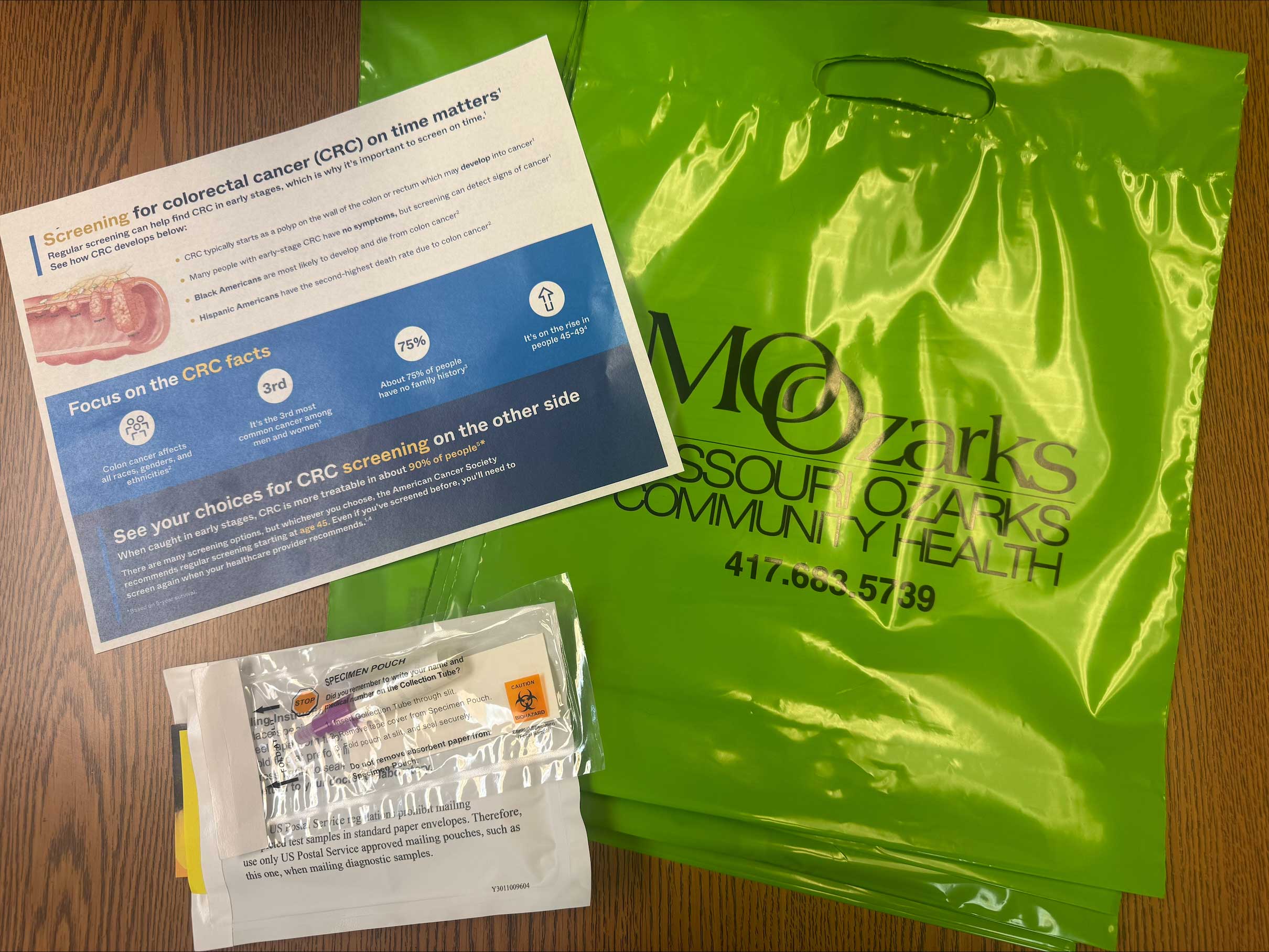
Missouri Ozarks Community Health offers multiple screening options. Patients can request at-home stool testing kits, including the FIT test and Cologuard test—both non-invasive options that are covered by insurance and available through the clinic’s sliding fee program. “For any patient who requests a FIT test, we send home the screening kit in a green bag along with information about colorectal cancer,” said Sherry Smith, a care coordinator at Missouri Ozarks. “Last year, we sent out 235 of those bags to our clinics.”
For patients who prefer a more comprehensive screening, providers can also offer referrals for colonoscopies. “There’s always going to be some disadvantages to the stool tests because we’re not actually visualizing the colon,” Vonderheide explained. “That can lead to false positives or negatives, and of course, you have to do more frequent testing.” A colonoscopy, she noted, is generally good for 10 years and is typically covered by insurance.
Vonderheide encourages patients who notice symptoms or have concerns to reach out promptly. “There can be a 90% cure rate or greater with very early stages of colorectal cancer,” said Vonderheide. “The sooner we can figure out what’s going on, the easier it will be to treat it.”
To learn more about colorectal cancer screening or to schedule an appointment, call the clinic nearest you:
- Ava Clinic: (417) 683-5739
- Gainesville Clinic: (417) 679-2775
- Mansfield Clinic: (417) 924-8809
- Cabool Clinic: (417) 962-5422
- Mountain Grove Clinic: (417) 926-1713
- Houston Clinic: (417) 967-0772
